
X-ray Scintillators for Industrial Inspection
X-ray scintillators for industrial inspection
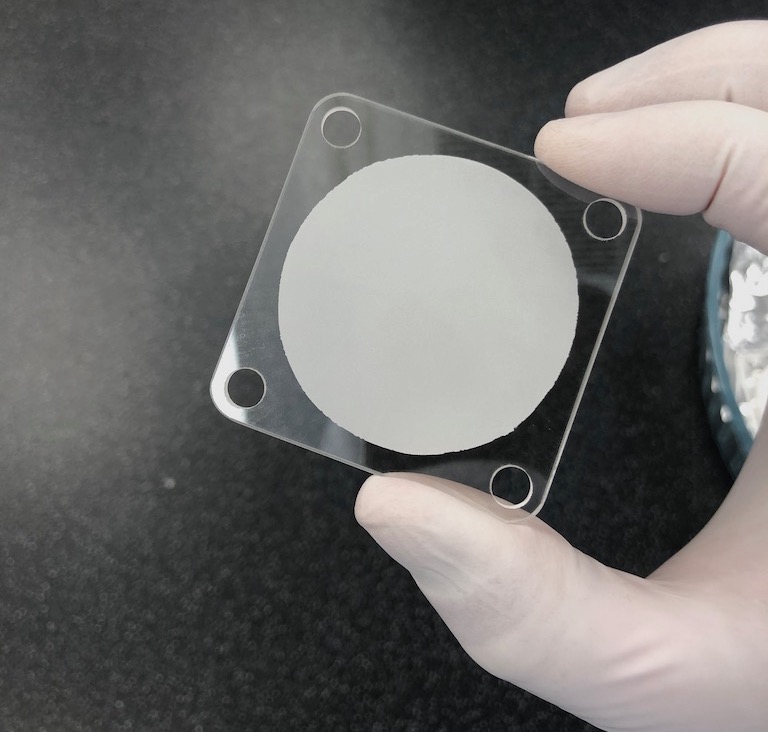
X-ray scintillators for industrial inspection are coated screens that convert X-rays into visible light, so an inspection system can produce an image of the inside of a component without cutting it open. That image is what reveals a void in a casting, a fault in a weld, a crack under a surface or something in a sealed pack that should not be in there. At Analytical Components we coat these screens to order at our facility in St Leonards on Sea.
We coat gadolinium oxysulfide (Gadox) onto the substrate, thickness and dimensions your equipment needs, in a Class 10,000 (ISO 7) cleanroom. Analytical Components is ISO 9001:2015 accredited.
Matching the material to the inspection job
We coat all three Gadox formulations. For X-ray scintillators for industrial inspection, the deciding factors are usually the energy of the beam, the speed the line runs at, and whether afterglow from one frame will smear into the next.
- Gadox:Tb emits yellow green light peaking at 545nm, with a range of 382 to 622nm, medium persistence and low afterglow. It coats very evenly and costs less, so it is the common choice for lower frame rate inspection where resolution and light output are the priorities.
- Gadox:Pr emits green light at 513nm, decays to 10% in around 7 microseconds and shows no afterglow. That makes it the material for ultra high speed imaging and for backscatter detectors.
- Gadox:Eu emits red light at 627nm and is used where beam energy is extremely high, such as inspection through thick or dense sections.
Gadox:Tb and Gadox:Pr are both used with hard X-rays. Alongside inspection of large objects by radiography, the screens we coat are used in dual energy computed tomography (DECT) and in backscatter
How the screen fits into an inspection system
The X-ray source sits on one side of the part being inspected and the detector sits on the other. X-rays that make it through the part strike the scintillator, the phosphor coating absorbs that energy, and it re-emits it as visible photons. A silicon sensor, typically a CCD or CMOS detector, reads the light and builds the image your inspector or your vision software works from.
Gadox, also written Gd2O2S, GOS or P43, is the most widely used phosphor in X-ray applications. It has comparatively high luminescent efficiency, its material characteristics are well understood, and the wavelengths it emits are ones silicon detectors read efficiently. If the screen and the sensor are not well matched, image quality suffers regardless of what the rest of the system cost.
Substrates that stand up to a production environment
Industrial equipment asks more of a screen than a laboratory bench does, so substrate choice matters. We coat Gadox onto glass and fibre optic plates (FOPs), and onto metals including stainless steel, copper and aluminium, which is often the sensible route where a screen has to be handled, mounted or cleaned regularly. We also coat specialist materials such as Mylar and silicon, and can coat directly onto the cathode of a vacuum tube.
We are continually investing in new coating methods, so there is usually more than one way to approach a given material, and we will recommend the method best suited to the substrate you are working with.
Why choose Analytical Components
We deal with customers directly and we would rather spend time getting a specification right than supply something that almost works. Repeat production orders and single bespoke pieces both go through the same process here.
You can have updates on your order by phone or email at any point, and you are welcome to come and see the production facility, which we encourage. Customer confidentiality matters to us and we offer NDAs where they apply.
Analytical Components is ISO 9001:2015 accredited, so we have demonstrated that we can consistently supply products that meet customer and regulatory requirements. Our Class 10,000 (ISO 7) cleanroom and our raw material selection are what keep the coating process and the finished screens consistent batch to batch.
Our ISO 9001:2015 certificate, RoHS and REACH documentation can be downloaded from our downloads page. There is more about Analytical Components on our about page.

Talk to us about X-ray scintillators for industrial inspection
If you are looking for X-ray scintillators for industrial inspection, for security equipment or for use as energy detectors, get in touch and tell us what the system has to do. Fill in our contact form, email info@analyticalcomponents.uk, or call +44 (0) 1424 850004. The sensor type, the beam energy and the screen dimensions are usually enough for us to recommend a material.
Analytical Components scintillators are used across a range of fields. They support accurate diagnosis and treatment in hospitals, medical imaging, dental imaging and veterinary imaging. They are used for security screening and industrial inspection, where the priority is safety and product quality. They also support work in nuclear research and university and college research.