
EBSD Phosphor Screens for Earth Science
EBSD Phosphor Screens for Earth Science are the component that turns a diffracted electron pattern into something a camera can record, and Analytical Components coat them at our facility in St Leonards on Sea. We regularly supply EBSD screens for earth science research. This page covers what the technique is used for in the earth sciences, how a diffraction pattern forms, and the sizes and substrates we can coat.
What Earth Science Research Uses EBSD For
Earth science covers every type of science relating to planet Earth. That breadth means a wide range of analytical equipment gets used across the field, and electron backscatter diffraction is part of it.
Two uses come up in particular. EBSD is used to distinguish clay polytypes, and it helps characterise the microstructures of crystalline materials. EBSD Phosphor Screens for Earth Science are what make both of those measurements readable.
Kikuchi Bands and How They Form
The technique runs in a scanning electron microscope (SEM) and returns quantitative microstructure analysis data. Crystal orientation, phase grain statistics, phase and strain conditions and defects all come out of it.
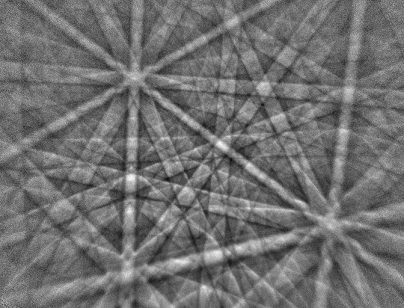
An electron beam is fired at a prepared crystalline sample. Some electrons are absorbed. Others escape, and those exiting near the Bragg angle diffract to form Kikuchi bands, each band corresponding to a lattice diffracting crystal plane. Those bands land on the screen, which is where our part of the job begins.
Our EBSD phosphor screen page carries the rest of the detail, including how the pattern is read and indexed.
Phosphor Types and What They Do
Phosphors are designated by the letter P followed by a number, and they are often rare earth compounds combined with an activator. The activator is what sets the behaviour. It can prolong the emission time, known as afterglow, or quench it and shorten it. The parameters that describe a phosphor are its wavelength of emission in nanometres, its peak width, and its decay time.
Analytical Components are very experienced working with P22G, P43, P46 and P47, and we are happy to discuss the wider range of phosphor types available. Which one belongs in your screen depends on the system and the work, so it is worth raising when you first contact us.
Sizes, Substrates and Special Builds
Our coating techniques and equipment let us put EBSD Phosphor Screens for Earth Science onto a variety of substrates, including float glass and fibre optic plates (FOPs). Sizes run between 10 and 150mm square, plus the equivalent sizes in diameter. Need something bigger, or a substrate that is neither a square nor a circle? Ask us and we will look at it.

Coated to Your Specification
EBSD Phosphor Screens for Earth Science are coated in our cleanroom using specialist equipment. Analytical Components are ISO 9001:2015 accredited, and we manufacture in line with each customer’s individual specification rather than to a catalogue.
Our certificate and other company documentation sit on the downloads page, and there is more about Analytical Components on our about page.
Next Steps
To talk through EBSD Phosphor Screens for Earth Science, fill in our contact form, email info@analyticalcomponents.uk, or call +44 (0) 1424 850004.
EBSD Phosphor Screens for Earth Science are one part of what we do. We also coat EBSD screens for metal research, microelectronics, nuclear research and academia.